

Two HVAC companies in Alabama, both doing $2.5 million in annual revenue.
One sells for $3.8 million. The other struggles to find a buyer at $1.2 million.
Same industry. Same market. Same top-line number.
Wildly different outcomes.
If you've ever Googled "business valuation Alabama" hoping for a simple formula, revenue times some magic number, you've already discovered the frustrating truth: it doesn't work that way.
Revenue tells you almost nothing about what a buyer will actually pay.
What Buyers Pay For (And It's Not Your Sales Number)
Here's what most Alabama business owners get wrong when they start thinking about their company's value.
They look at revenue and assume that's the starting point.
It's not.
Buyers pay for cash flow they can actually take home. They pay for assets they can use. They pay for businesses they believe will continue performing after you're gone.
Revenue is just the top of the income statement. What happens between that line and the bottom line? That's where value gets created or destroyed.
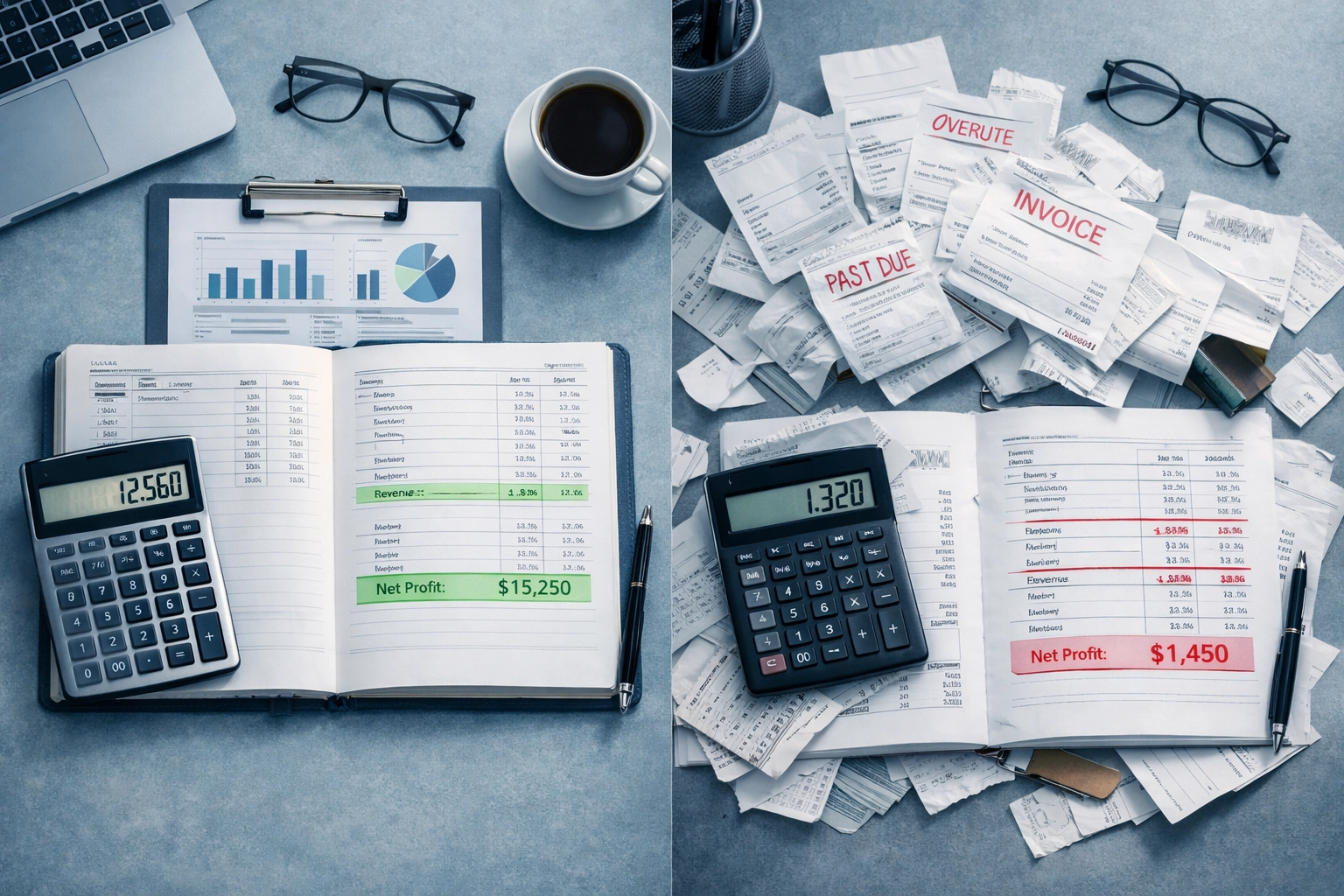
Let me show you why this matters.
Two manufacturing businesses in Birmingham. Both hitting $3 million in annual sales.
Company A operates on 35% gross margins with tight expense controls. The owner takes home $750,000 annually after paying themselves a reasonable salary. Equipment is well-maintained but mostly leased. Customer concentration is spread across 40 accounts.
Company B runs on 18% margins because of outdated processes and overstaffing. The owner nets $200,000 after expenses. They own their building and equipment outright. Three customers represent 65% of revenue.
Both are "$3 million businesses."
But Company A might sell for 4-5x its cash flow, somewhere around $3-3.75 million.
Company B? Maybe 2x cash flow if a buyer feels confident about those major customers. That's $400,000.
Same revenue. Completely different values.
The Three Ways Professional Valuators Actually Calculate Worth
When you work with someone who holds credentials like ABV, CVA, or ASA, the recognized professional standards for business valuation in Alabama, they don't just multiply your revenue by a number they found online.
They use three distinct approaches. Sometimes all three. Sometimes a combination.
The Income Approach: What You Actually Make
This method focuses entirely on profitability and cash flow.
Not what you sold. What you kept.
Two restaurants in Mobile might both gross $1.8 million. One runs at 8% net profit because of high labor costs and a expensive lease. The other hits 22% because the owner figured out systems that work.
The second restaurant is worth nearly three times what the first one is.
The income approach looks at what's called "seller's discretionary earnings", the actual cash benefit to an owner. That includes your salary, the profit left over, interest payments, depreciation, and any personal expenses you run through the business.
A valuator will normalize your earnings, removing one-time expenses or unusual circumstances, then apply a multiple based on risk factors specific to your business.
The Market Approach: What Similar Businesses Actually Sold For
This compares your company to others that recently changed hands.
But here's where Alabama market factors matter more than most owners realize.
A retail business in Huntsville operates in a different competitive environment than the same type of business in Dothan. Growth trajectories differ. Buyer pools differ. Local economic conditions differ.

The market approach considers size, industry focus, financial performance, growth potential, and geographic factors.
A coastal Alabama tourism business might command a premium because of the consistent Gulf Coast visitor economy. That same business model in a rural area faces different demand patterns.
Professional valuators use databases of actual sale transactions, adjusting for differences between your business and the comparables. They're looking for businesses similar in revenue, profitability, industry, and market position.
The Asset Approach: What You Actually Own
This calculates value by looking at total asset value minus what you owe.
For some businesses, this matters enormously. For others, it's almost irrelevant.
A logistics company in Montgomery that owns its warehouse, trucks, and equipment has tangible assets that create a floor value. Even if operations struggle, those assets hold worth.
A consulting firm in Birmingham might have $50,000 in office furniture and computers. The asset value is negligible.
But don't ignore intangible assets, the things you can't touch but buyers will pay for:
- Customer lists and relationships
- Proprietary processes or recipes
- Brand reputation and market position
- Trained workforce
- Non-compete agreements
- Vendor relationships and favorable terms
I've seen Alabama businesses with modest revenue sell for surprising amounts because they owned something buyers couldn't easily replicate. A pest control company with 15 years of customer contracts. A manufacturer with exclusive distribution rights. A service business with a recognized brand across North Alabama.
The Factors That Create Value Gaps Between Similar Businesses
Beyond the three formal approaches, specific operational realities drive the difference between strong valuations and disappointing ones.
Customer concentration might be the biggest value killer I see in Alabama businesses. If losing one customer would drop your revenue by 25% or more, buyers will either walk away or heavily discount their offer. Diversification creates value.
Owner dependence runs a close second. If you're the only person who can do sales, manage key relationships, or run core operations, you don't have a business, you have a job. Buyers pay for businesses that can run without you.
Recurring revenue commands premium multiples in any market. A pest control company with 400 monthly contracts is worth more than a construction company chasing new projects constantly, even at the same revenue level.
Systems and documentation separate professional operations from one-person shows. Written procedures, training manuals, operational playbooks, these signal to buyers that the business won't fall apart during transition.

Market position matters more in Alabama than many owners realize. Are you the established player in Tuscaloosa County? Do you dominate a niche in the Gulf Coast market? Or are you one of a dozen similar options fighting on price?
Position creates pricing power. Pricing power creates margins. Margins create value.
Alabama-Specific Market Factors That Affect Your Business Value
The Alabama economy isn't monolithic.
What drives value in Baldwin County differs from what matters in the Tennessee Valley.
Coastal businesses in Mobile, Gulf Shores, and Orange Beach often benefit from tourism stability and population growth. But they also face higher competition and seasonal fluctuations that buyers factor into risk assessments. A restaurant in Gulf Shores might see 60% of its annual revenue in six months. That concentration affects valuation.
Manufacturing and industrial operations around Huntsville, Birmingham, and Montgomery can command strong valuations when tied to aerospace, automotive, or defense industries with long-term stability. The Huntsville market, particularly, attracts buyers looking for businesses serving government contractors or tech sector companies.
Agricultural and rural businesses face different dynamics. Lower competition, yes. But smaller buyer pools. A farm supply business in a small Alabama town might be highly profitable and essential to the community: but finding the right buyer takes longer, which affects leverage in negotiations.
Urban vs. rural market positioning changes everything about how valuators approach your business. Urban businesses typically have access to more buyers, better labor pools, and stronger infrastructure. That shows up in comparable sale data and affects the multiples applied to your earnings.
The Alabama market also still sees significant family business transitions. Multi-generational companies often have clean financials, established reputations, and deep community ties: all factors that can increase value if properly documented and transferred.
What To Do With This Information
If you're trying to estimate your business value, understand that any number you calculate yourself is probably wrong.
Not because you're incapable. Because you lack the comparative data, the objectivity, and the methodology that professional business valuation requires.
But knowing these factors helps you do something more valuable than guess at a number: you can start building value intentionally.
Reduce customer concentration. Document your systems. Decrease your involvement in daily operations. Improve margins. Build recurring revenue.
These aren't just good business practices. They're value creation strategies that directly impact what someone will pay when you're ready to exit.
Every Alabama business owner should know roughly what their company is worth: not because you're ready to sell, but because that number tells you where you're building value and where you're leaving money on the table.
A professional business valuation in Alabama typically runs $3,000-$10,000 depending on complexity. For most owners, it's the clearest money they'll ever spend. It removes the guessing. It shows you what buyers will focus on. It gives you a roadmap for the next 2-5 years if you want to maximize your exit.
At Business Broker Alabama, we've helped owners across the state understand what their businesses are actually worth: and more importantly, why.
Sometimes the number is higher than expected. Sometimes it reveals work that needs doing.
Either way, clarity beats guessing.
If you want to know where your business stands, we offer confidential business valuations that use all three professional approaches. No obligation. No pressure. Just the number and the reasoning behind it.
Because whether you're selling next year or a decade from now, knowing your business value changes how you run your company today.